
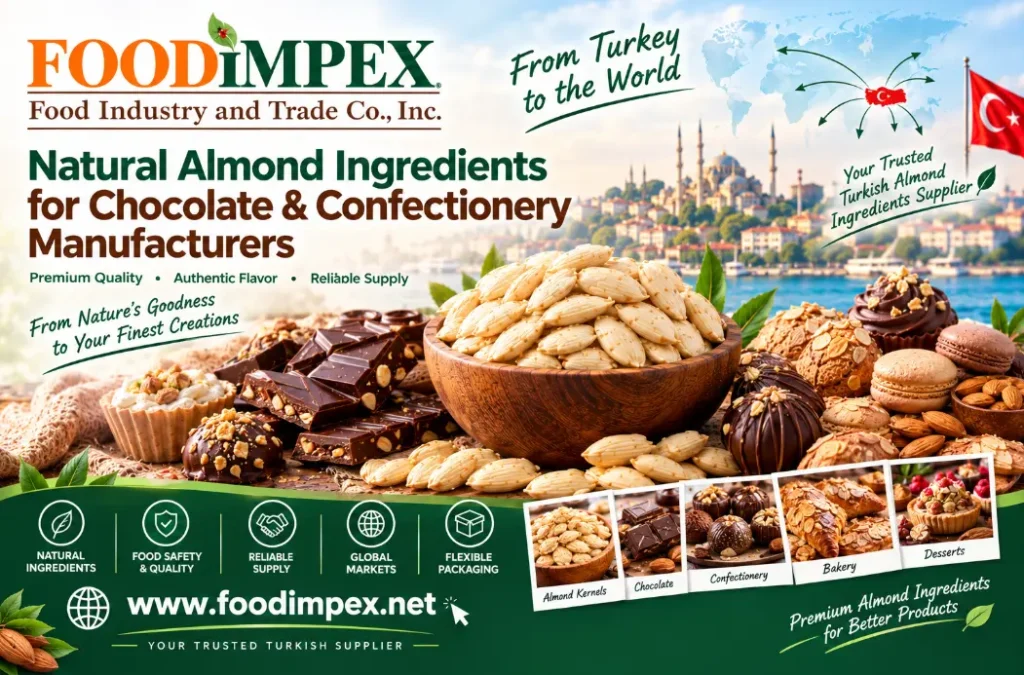
Choosing the Right Almond Kernel Supplier for Confectionery Production
For chocolate and confectionery manufacturers, ingredient sourcing directly affects product consistency, production continuity, food safety, and ultimately brand reputation. Almond kernels may represent only one component of a formulation, but an inconsistent or unsuitable supply can create problems across an entire manufacturing process.
This is why choosing an almond kernel supplier should involve much more than comparing price per kilogram.
Professional purchasing teams evaluate product specifications, origin, food safety, traceability, processing standards, packaging, documentation, logistics, and the supplier’s ability to maintain dependable supply over time. For specialty products such as bitter almonds, technical and regulatory assessment becomes even more important.
Turkey offers international confectionery manufacturers a strategic sourcing location supported by agricultural expertise, established food-export infrastructure, and proximity to major European markets. Food Impex supplies Turkish agricultural products and natural food ingredients to international B2B customers, including manufacturers, importers, distributors, ingredient buyers, and private label companies.
This guide explains the most important factors to consider when selecting a bitter almond kernels supplier or almond ingredient partner for professional confectionery production.
Understanding Almond Kernel Requirements in Confectionery Production
Almond ingredients are widely associated with chocolate and confectionery manufacturing, but purchasing requirements vary considerably between products.
A chocolate manufacturer producing almond inclusions may prioritize kernel size, appearance, texture, and consistency. A producer developing fillings or processed formulations may have different requirements relating to flavor, processing characteristics, particle size, or other technical parameters.
Before requesting quotations, buyers should therefore establish a clear specification covering the required almond type, format, intended application, annual volume, packaging, destination, and quality parameters.
This distinction is particularly important when discussing Turkish bitter almond kernels.
Bitter almonds are not interchangeable with conventional sweet almonds. They contain naturally occurring cyanogenic glycosides, including amygdalin, which can release hydrogen cyanide. Their use consequently requires appropriate food-safety assessment, processing controls, analytical requirements, and compliance with the regulations applicable to the intended product and destination market.
For confectionery manufacturers, supplier selection should therefore begin with the application and technical specification—not simply product availability.
What Should Confectionery Buyers Look for in an Almond Kernel Supplier?
A reliable supplier should be able to understand both commercial and technical requirements.
Purchasing managers should consider five interconnected factors: product quality, food safety, traceability, export capability, and supply reliability. Weakness in any one area can increase the total risk of procurement.
Clear Product Specifications
The supplier and buyer should establish measurable specifications before confirming an order.
Depending on the product, these may address origin, kernel condition, physical characteristics, size or grade, moisture, foreign material, processing status, packaging, storage conditions, and buyer-specific analytical requirements.
For confectionery manufacturers, consistency is especially important because changes in raw materials may affect processing performance or finished-product characteristics.
A professional supplier should therefore work according to agreed specifications rather than relying only on broad descriptions such as “premium quality.”
Product Selection and Sorting
Raw material selection is an important stage in almond kernel supply.
Depending on the contracted product and processing system, preparation may include cleaning, inspection, sorting, grading, and removal of unsuitable material. Buyers should ask which processes actually apply to the specific product being offered.
This is particularly relevant for repeat orders. Manufacturers need confidence that successive lots can continue to meet agreed requirements rather than receiving substantially different products from shipment to shipment.
Food Safety Requirements for Bitter Almond Kernels
Food safety deserves particular attention when sourcing bitter almonds for confectionery or other food applications.
Bitter almonds can naturally contain higher concentrations of cyanogenic glycosides than conventional sweet almonds. These compounds can release hydrogen cyanide under certain conditions. As a result, raw bitter almonds should never be treated simply as a more intensely flavored substitute for ordinary almonds.
For manufacturers, this means the intended application should be evaluated by qualified food-safety, regulatory, and product-development personnel.
Buyers may need to define requirements relating to hydrocyanic acid, microbiological parameters, pesticide residues, contaminants, allergens, and other parameters applicable to their product and destination market.
For European companies, current EU food-safety legislation and the requirements applicable to the precise ingredient and finished product should be checked before commercial use.
A responsible bitter almond kernels exporter should be prepared to discuss the buyer’s intended application and technical requirements rather than making unsupported claims that every batch is suitable for every confectionery use.
Traceability: An Essential Supplier Qualification Criterion
Traceability has become a fundamental requirement in international food manufacturing.
Confectionery manufacturers should be able to connect incoming ingredients with appropriate batch and supplier information. Depending on the agreed system, traceability records may cover sourcing, processing, packing, and shipment identification.
This helps buyers with supplier approval, internal quality management, investigations, audits, and corrective actions.
For international ingredient sourcing, documentation may be as important as physical product quality. A shipment that meets sensory expectations but arrives without required documentation can still create significant operational problems.
When comparing suppliers, purchasing teams should therefore ask how batches are identified and what traceability information can be provided.
Why Turkey Is a Strategic Source for Almond Ingredients
Agricultural Expertise
Turkey has a long-established agricultural sector and extensive experience in the production, processing, and international trade of nuts, dried fruits, seeds, herbs, pulses, and other natural food ingredients.
This ecosystem connects growers with processors, packers, exporters, laboratories, logistics providers, and international customers.
For confectionery companies, sourcing through an experienced Turkish exporter can provide access to origin-based agricultural supply combined with professional international trade support.
Suitable Agricultural Conditions
Turkey’s diverse agricultural regions and climatic conditions support a broad range of crops and tree nuts. Agricultural knowledge developed over generations also contributes to established sourcing networks.
For international buyers, supplier relationships built close to agricultural origin can provide better visibility into seasonal conditions, availability, and procurement planning.
Proximity to European Confectionery Markets
Turkey’s geographical position is particularly relevant for European manufacturers.
Major confectionery markets in Germany, France, the Netherlands, the United Kingdom, Italy, Belgium, and other European countries can be served through established transport connections from Turkey.
Depending on destination and logistics mode, this proximity can support shorter transportation routes and more flexible supply planning compared with certain distant origins.
Established Export Infrastructure
Professional agricultural exports require commercial documentation, customs coordination, transportation planning, certificates where applicable, and clear communication between buyer and supplier.
Working with an export-oriented partner helps procurement departments manage these operational requirements more efficiently.
Packaging Options for Confectionery Manufacturers
Packaging should protect the product while fitting the manufacturer’s receiving, warehousing, and production systems.
Bulk Packaging
Industrial manufacturers purchasing regular volumes generally require commercially efficient bulk formats.
When sourcing bulk bitter almonds, buyers should establish the precise packaging specification during quotation. Relevant factors can include net weight, inner packaging, carton or bag type, pallet configuration, labeling, lot identification, and storage requirements.
Packaging should not be treated as an afterthought because changes in pack format can affect warehouse operations and manufacturing efficiency.
Export Cartons
Export cartons can provide practical handling, stacking, palletization, and transportation for international shipments.
Buyers should confirm the exact carton configuration offered for their order rather than assuming a standard format.
Vacuum Packaging
Where technically suitable and commercially available for the contracted product, vacuum packaging may be considered as an additional product-protection option.
Its suitability should be assessed according to product characteristics, storage conditions, shipment duration, and buyer requirements.
Customized and Private Label Packaging
Distributors and private label businesses may require customized formats.
Projects can involve specific weights, labeling, branding, destination languages, barcodes, or other market-specific information. Because such requirements can influence minimum quantities, costs, and lead times, they should be discussed early in the procurement process.
Applications in Confectionery and Specialty Food Manufacturing
Chocolate and Confectionery
Almond ingredients have established applications across chocolate bars, pralines, fillings, coated confectionery, and specialty products.
For bitter-almond-related formulations, manufacturers should distinguish between raw bitter almond kernels and appropriately processed or otherwise compliant ingredients intended to deliver the desired characteristic profile.
The precise solution depends on the formulation and applicable regulatory requirements.
Bakery and Pastry Manufacturing
Almond ingredients are also important in commercial bakery and pastry production, including fillings, baked goods, and specialty formulations.
Where bitter almond characteristics are required, manufacturers should validate the ingredient’s processing and application conditions rather than directly substituting raw bitter kernels for conventional almonds.
Natural and Specialty Ingredient Formulations
Ingredient companies may also source almond materials for downstream processing or specialty formulations.
Companies searching for a natural food ingredients supplier Turkey should evaluate not only the product portfolio but also the exporter’s ability to provide clear specifications, traceability, documentation, packaging, and long-term supply support.
Responsible Agricultural Sourcing
Sustainability and responsible sourcing are increasingly incorporated into supplier qualification programs.
International manufacturers may assess agricultural origin, traceability, environmental practices, supplier relationships, human-rights risks, and long-term supply-chain resilience.
The Food and Agriculture Organization of the United Nations provides resources and global food and agriculture guidelines relevant to responsible and sustainable agricultural systems.
For B2B buyers, credible sustainability management should be based on documented practices and appropriate due diligence rather than broad environmental marketing claims.
Export Experience and Documentation Support
The right almond kernel supplier should also understand international trade.
Depending on the shipment and destination, export processes may involve commercial invoices, packing lists, transport documents, customs information, product documentation, certificates, and buyer-specific requirements.
Professional communication is equally important.
A purchasing manager should receive clear answers regarding availability, specifications, MOQ, packaging, lead time, shipment terms, documentation, and quotation validity. Quality departments may require separate technical information, while logistics teams need accurate shipment details.
A capable exporter coordinates these requirements rather than leaving the buyer to resolve them after the order has been placed.
Supply Reliability for Continuous Confectionery Production
Confectionery manufacturers cannot evaluate suppliers only on the basis of the first shipment.
Production facilities require continuity.
Unexpected ingredient shortages can disrupt manufacturing schedules, inventory levels, customer deliveries, and promotional plans. Buyers should therefore assess whether the supplier can support forecast volumes and communicate potential availability changes early.
For recurring orders, manufacturers should consider sharing estimated monthly, quarterly, or annual demand.
This can help both sides plan sourcing, packaging, documentation, and logistics more effectively.
Long-term supplier relationships also create opportunities to improve specifications and purchasing processes over time.
A Practical Buyer Checklist Before Requesting a Quotation
Before selecting an almond supplier for confectionery production, procurement teams should verify:
- the exact almond type and intended manufacturing application;
- agreed physical and technical specifications;
- food-safety and analytical requirements, particularly for bitter almonds;
- batch identification and traceability capability;
- applicable destination-market compliance requirements;
- packaging format, net weight, and pallet configuration;
- MOQ and available commercial volumes;
- expected lead time and shipment frequency;
- Incoterms and destination;
- required quality and export documentation;
- capacity to support repeat orders and forecasts;
- responsiveness of commercial and technical communication.
A well-structured RFQ helps buyers compare suppliers on equivalent terms and reduces misunderstandings later in the purchasing process.
Food Impex as a Turkish Almond Kernel Supply Partner
Food Impex supplies Turkish agricultural products and natural food ingredients to international markets.
For companies specifically evaluating bitter almond sourcing, product information is available through Food Impex as a Turkish bitter almond kernels supplier.
International buyers should provide as much detail as possible when making an inquiry, including destination country, intended application, required quantity, technical specifications, packaging preference, documentation requirements, and expected purchasing frequency.
This allows Food Impex to assess the commercial requirement more effectively and discuss an appropriate sourcing and export solution.
For confectionery manufacturers in particular, this application-led approach is preferable to purchasing a specialty almond product without first establishing whether its technical characteristics meet the intended formulation.
Frequently Asked Questions
What should a confectionery manufacturer look for in an almond kernel supplier?
Buyers should evaluate product specifications, quality consistency, food-safety controls, traceability, packaging, documentation, export experience, supply capacity, and communication. For recurring industrial orders, the supplier’s ability to support forecast demand is particularly important.
Are bitter almond kernels the same as conventional sweet almonds?
No. Bitter almonds have different sensory and chemical characteristics and can contain higher levels of cyanogenic glycosides. They should not be treated as direct substitutes for conventional sweet almonds.
Can bitter almond kernels be used in confectionery production?
They may be relevant to selected applications, but suitability depends on the precise product, processing, formulation, analytical characteristics, intended use, and applicable legislation. Manufacturers should complete appropriate technical and regulatory assessment before use.
Why source almond kernels from Turkey?
Turkey combines agricultural expertise, established sourcing networks, international export infrastructure, and geographical proximity to major European markets. These characteristics can make it a strategically attractive origin for international food manufacturers.
Can Food Impex supply bulk bitter almonds?
Food Impex markets Turkish-origin bitter almond kernels to international B2B buyers. Buyers should request current specifications, availability, MOQ, packaging formats, lead times, documentation, and commercial terms for their particular requirement.
What information should a confectionery buyer include in an RFQ?
A useful RFQ should include the required product, destination country, intended application, technical specification, quantity or annual forecast, packaging requirements, delivery terms, required documentation, and target shipment schedule.
Conclusion: Choose an Almond Kernel Supplier That Supports Your Production
Choosing the right almond kernel supplier for confectionery production is ultimately a risk-management and supply-chain decision.
Price matters, but the lowest quotation does not necessarily deliver the lowest total procurement cost. Inconsistent specifications, documentation errors, delayed shipments, unsuitable packaging, food-safety issues, or unreliable availability can create costs far beyond the initial difference in ingredient price.
For bitter almonds in particular, supplier selection requires additional care. Manufacturers need to address cyanogenic compounds, analytical requirements, processing, intended use, and destination-market compliance before incorporating the ingredient into commercial production.
Turkey offers confectionery manufacturers an attractive combination of agricultural experience, strategic geography, established export infrastructure, and access to natural food ingredient supply networks.
Food Impex aims to support international manufacturers, importers, distributors, ingredient buyers, and private label businesses as a reliable bitter almond kernels supplier, experienced bitter almond kernels exporter, and professional natural food ingredients supplier Turkey.
Planning an almond ingredient purchase for confectionery production? Contact Food Impex with your destination country, intended application, required volume, technical specification, packaging preference, and documentation requirements to request a B2B quotation and discuss a dependable Turkish sourcing solution.